

Ace PMI CAPM Certification with Actual Questions Jan 04, 2026 Updated
2026 The Most Effective CAPM with 1308 Questions Answers
PMI CAPM Certification Exam covers a wide range of topics related to project management, including project initiation, planning, execution, monitoring and controlling, and closing. It also covers areas such as project scope management, time management, cost management, quality management, communication management, risk management, and stakeholder management. CAPM exam consists of 150 multiple-choice questions and has a time limit of three hours.
To be eligible for the CAPM certification, candidates must have a high school diploma or an equivalent degree and have completed 23 hours of project management education. The CAPM certification is an excellent way for individuals to demonstrate their commitment to the project management profession and to enhance their career prospects. It is also a valuable credential for organizations that want to ensure their project managers have the necessary skills and knowledge to manage projects effectively.
To be eligible for the PMI CAPM exam, candidates must have a secondary diploma or a global equivalent and have completed 23 hours of formal project management education. The education requirement can be met through a variety of formats, including online courses, instructor-led courses, and university or college courses.
NEW QUESTION # 387
Who is responsible for developing the project management plan and all related component plans?
- A. Project management office
- B. Project manager
- C. Project team
- D. Portfolio manager
Answer: B
NEW QUESTION # 388
Who, along with the project manager, is supposed to direct the performance of the planned project activities and manage the various technical and organizational interfaces that exist within the project?
- A. The risk owners and stakeholders
- B. The project management team
- C. The customer and functional managers
- D. The sponsors and stakeholders
Answer: B
Explanation:
Section: Volume C
NEW QUESTION # 389
What describes the relationship between projects, programs, and portfolios?
- A. Program management focuses on doing the "specific" portfolios and projects
- B. Portfolio management focuses on doing the "right" programs and projects
- C. Project management focuses on doing the "right" programs and portfolios
- D. Portfolio management focuses on doing the "specific" programs and projects
Answer: B
Explanation:
Section: Volume E
NEW QUESTION # 390
The stakeholder register is an output of:
- A. Identify Stakeholders.
- B. Plan Stakeholder Management.
- C. Control Stakeholder Engagement.
- D. Manage Stakeholder Engagement.
Answer: A
Explanation:
Section: Volume C
Explanation:
5.2.1.5 Stakeholder Register
Described in Section 13.1.3.1. The stakeholder register is used to identify stakeholders who can provide information on the requirements. The stakeholder register also captures major requirements and main expectations stakeholders may have for the project.
13.1.3.1 Stakeholder Register
The main output of the Identify Stakeholders process is the stakeholder register. This contains all details related to the identified stakeholders including, but not limited to:
Identification information. Name, organizational position, location, role in the project, contact information;
Assessment information. Major requirements, main expectations, potential influence in the project, phase
in the life cycle with the most interest; and
Stakeholder classification. Internal/external, supporter/neutral/resistor, etc.
The stakeholder register should be consulted and updated on a regular basis, as stakeholders may change- or new ones identified-throughout the life cycle of the project.
Process: 13.1 Identify Stakeholders
Definition: The process of identifying the people, groups, or organizations that could impact or be impacted by a decision, activity, or outcome of the project; and analyzing and documenting relevant information regarding their interests, involvement, interdependencies, influence, and potential impact on project success.
Key Benefit: The key benefit of this process is that it allows the project manager to identify the appropriate focus for each stakeholder or group of stakeholders.
Inputs
1. Project charter
2. Procurement documents
3. Enterprise environmental factors
4. Organizational process assets
Tools & Techniques
1. Stakeholder analysis
2. Expert judgment
3. Meetings
Outputs
1. Stakeholder register
NEW QUESTION # 391
When should quality planning be performed?
- A. As a separate step from the other planning processes
- B. As part of a detailed risk analysis
- C. In parallel with the other planning processes
- D. While developing the project charter
Answer: C
Explanation:
Section: Volume A
Explanation:
Quality planning should be performed in parallel with the other planning processes. For example, proposed changes in the deliverables to meet identified quality standards may require cost or schedule adjustments and a detailed risk analysis of the impact to plans.
The quality planning techniques discussed here are those used most frequently on projects. There are many others that may be useful on certain projects or in some application areas.
NEW QUESTION # 392
Which of the following is a conflict resolution technique that emphasizes areas of agreement rather than areas of difference?
- A. Compromising
- B. Smoothing
- C. Problem Solving
- D. Collaborating
Answer: B
Explanation:
Section: Volume D
Explanation:
There are five general techniques for resolving conflict. As each one has its place and use, these are not given in any particular order:
Withdraw/Avoid. Retreating from an actual or potential conflict situation; postponing the issue to be better
prepared or to be resolved by others.
Smooth/Accommodate. Emphasizing areas of agreement rather than areas of difference; conceding one's
position to the needs of others to maintain harmony and relationships.
Compromise/Reconcile. Searching for solutions that bring some degree of satisfaction to all parties in order
to temporarily or partially resolve the conflict.
Force/Direct. Pushing one's viewpoint at the expense of others; offering only win-lose solutions, usually
enforced through a power position to resolve an emergency.
Collaborate/Problem Solve. Incorporating multiple viewpoints and insights from differing perspectives;
requires a cooperative attitude and open dialogue that typically leads to consensus and commitment.
NEW QUESTION # 393
Which process is conducted from project inception through completion and is ultimately the responsibility of the project manager?
- A. Control Scope
- B. Monitor and Control Project Work
- C. Perform Integrated Change Control
- D. Control Quality
Answer: C
NEW QUESTION # 394
The following chart contains information about the tasks in a project.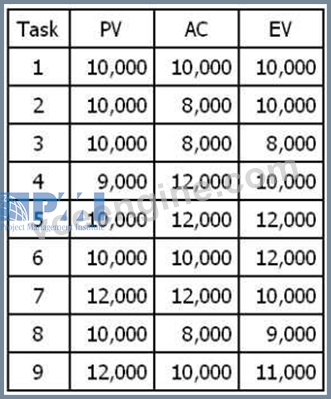
Based on the chart, what is the cost performance index (CPI) for Task 2?
- A. 0.8
- B. 0
- C. 1.25
- D. 1.8
Answer: C
Explanation:
Section: Volume B
NEW QUESTION # 395
In which phase of team building activities do team members begin to work together and adjust their work habits and behavior to support the team?
- A. Storming
- B. Forming
- C. Norming
- D. Performing
Answer: C
Explanation:
Section: Volume B
Explanation:
One of the models used to describe team development is the Tuckman ladder (Tuckman, 1965; Tuckman & Jensen, 1977), which includes fve stages of development that teams may go through. Although it's common for these stages to occur in order, it's not uncommon for a team to get stuck in a particular stage or slip to an earlier stage. Projects with team members who worked together in the past may skip a stage.
Forming. This phase is where the team meets and learns about the project and their formal roles and
responsibilities. Team members tend to be independent and not as open in this phase.
Storming. During this phase, the team begins to address the project work, technical decisions, and the
project management approach. If team members are not collaborative and open to differing ideas and perspectives, the environment can become counterproductive.
Norming. In the norming phase, team members begin to work together and adjust their work habits and
behaviors to support the team. The team learns to trust each other.
Performing. Teams that reach the performing stage function as a well-organized unit. They are
interdependent and work through issues smoothly and effectively.
Adjourning. In the adjourning phase, the team completes the work and moves on from the project. This
typically occurs when staff is released from the project as deliverables are completed or as part of carrying out the Close Project or Phase process (Section 4.6).
The duration of a particular stage depends upon team dynamics, team size, and team leadership. Project managers should have a good understanding of team dynamics in order to move their team members through all stages in an effective manner.
NEW QUESTION # 396
Which of the following correctly explains the term "progressive elaboration'?
- A. Changing project specifications continuously
- B. Project specifications becoming more explicit and detailed as the project progresses
- C. Elaborate tracking of the project progress
- D. Elaborate tracking of the project specifications with a change control system
Answer: B
Explanation:
Section: Volume D
Explanation:
Progressive Elaboration. The iterative process of increasing the level of detail in a project management plan as greater amounts of information and more accurate estimates become available.
NEW QUESTION # 397
Which of the following is an output of Define Scope?
- A. Project charter
- B. Project schedule
- C. Project scope statement
- D. Project plan
Answer: C
Explanation:
Explanation/Reference:
Explanation:
Process: 5.3 Define Scope
Definition: The process of developing a detailed description of the project and product.
Key Benefit: The key benefit of this process is that it describes the product, service, or result boundaries by defining which of the requirements collected will be included in and excluded from the project scope.
Inputs
1. Scope management plan
2. Project charter
3. Requirements documentation
4. Organizational process assets
Tools & Techniques
1. Expert judgment
2. Product analysis
3. Alternatives generation
4. Facilitated workshops
Outputs
1. Project scope statement
2. Project documents updates
NEW QUESTION # 398
Which is the Define Scope technique used to generate different approaches to execute and perform the work of the project?
- A. Product analysis
- B. Expert judgment
- C. Build vs. buy
- D. Alternatives identification
Answer: D
Explanation:
Explanation/Reference:
Explanation:
Process: 5.3 Define Scope
Definition: The process of developing a detailed description of the project and product.
Key Benefit: The key benefit of this process is that it describes the product, service, or result boundaries by defining which of the requirements collected will be included in and excluded from the project scope.
Inputs
1. Scope management plan
2. Project charter
3. Requirements documentation
4. Organizational process assets
Tools & Techniques
1. Expert judgment
2. Product analysis
3. Alternatives generation
4. Facilitated workshops
Outputs
1. Project scope statement
2. Project documents updates
NEW QUESTION # 399
A project manager requesting industry groups and consultants to recommend project intervention is relying on:
- A. Expert judgment
- B. Stakeholder participation.
- C. Communication models.
- D. Enterprise environmental factors.
Answer: A
Explanation:
Explanation/Reference:
Explanation:
4.1.2.1 Expert Judgment
Definition: Judgment is often used to assess the inputs used to develop the project charter. Expert judgment is applied to all technical and management details during this process. Such expertise is provided by any group or individual with specialized knowledge or training and is available from many sources, including:
Other units within the organization,
Consultants,
Stakeholders, including customers or sponsors,
Professional and technical associations,
Industry groups,
Subject matter experts (SME), and
Project management office (PMO).
NEW QUESTION # 400
Which project documents can determine the budget?
- A. Business case, project charter, statement of work, and cost estimates
- B. Basis of estimates, cost estimates, project schedule, and risk register
- C. Procurement documents, contracts, requirements documentation, and basis of estimates
- D. Scope baseline, resource management plan, activity list, and assumption log
Answer: B
Explanation:
Explanation/Reference:
Reference: https://project-management-knowledge.com/definitions/d/determine-budget/
NEW QUESTION # 401
Which Define Activities tool or technique is used for dividing and subdividing the project scope and project deliverables into smaller, more manageable parts?
- A. Project analysis
- B. Inspection
- C. Decomposition
- D. Document analysis
Answer: C
Explanation:
Section: Volume B
Explanation/Reference:
Explanation:
5.4.2.1 Decomposition
Decomposition is a technique used for dividing and subdividing the project scope and project deliverables into smaller, more manageable parts. The work package is the work defined at the lowest level of the WBS for which cost and duration can be estimated and managed. The level of decomposition is often guided by the degree of control needed to effectively manage the project. The level of detail for work packages will vary with the size and complexity of the project. Decomposition of the total project work into work packages generally involves the following activities:
Identifying and analyzing the deliverables and related work;
Structuring and organizing the WBS;
Decomposing the upper WBS levels into lower-level detailed components;
Developing and assigning identification codes to the WBS components; and
Verifying that the degree of decomposition of the deliverables is appropriate.
Process: 6.2 Define Activities
Definition: The process of identifying and documenting the specific actions to be performed to produce the project deliverables.
Key Benefit: The key benefit of this process is to break down work packages into activities that provide a basis for estimating, scheduling, executing, monitoring, and controlling the project work.
Inputs
1. Schedule management plan
2. Scope baseline
3. Enterprise environmental factors
4. Organizational process assets
Tools & Techniques
1. Decomposition
2. Rolling wave planning
3. Expert judgment
Outputs
1. Activity list
2. Activity attributes
3. Milestone list
NEW QUESTION # 402
A project team is discussing an upcoming planned product launch of a highly visible technologically advanced artificial intelligence tool. The team is debating the aspect of iterative and hybrid approaches. Which aspect of tailoring would this best represent?
- A. Resource availability
- B. Life cycle approaches
- C. Technology support
- D. Project dimensions
Answer: C
NEW QUESTION # 403
During which process would stakeholders provide formal acceptance of the completed project scope?
- A. Control Scope
- B. Perform Quality Control
- C. Verify Scope
- D. Develop Schedule
Answer: C
NEW QUESTION # 404
In a demonstration meeting with a customer, the project team presented deliverables that were considered ready for customer use. The team based the results on a checklist of all the required criteria for the project.
Which of the following elements is the team using?
- A. Backlog refinement
- B. Definition of ready (DoR)
- C. Burndown chart
- D. Definition of done (DoD)
Answer: D
NEW QUESTION # 405
After winning a large government contract, a company needs to hire a portfolio manager What vital qualification should candidates possess?
- A. Ability to manage strategic goals across multiple projects
- B. Skills to manage a large project
- C. Competency to manage multiple projects that align departments
- D. Capability of managing project schedules
Answer: C
NEW QUESTION # 406
The review of a sellers progress toward achieving the goals of scope and quality within cost and schedule compared to the contract is known as:
- A. Payment systems.
- B. Work performance information.
- C. Procurement performance reviews.
- D. Inspections and audits.
Answer: C
NEW QUESTION # 407
When painting a bedroom, preparing the walls can be done while the paint is being chosen. This is an example of a:
- A. lag
- B. lead
- C. internal dependency
- D. mandatory dependency
Answer: B
Explanation:
Section: Volume B
Explanation:
6.3.2.2 Dependency Determination
Dependencies may be characterized by the following attributes: mandatory or discretionary, internal or external, as described below. Dependency has four attributes, but two can be applicable at the same time in following ways: mandatory external dependencies, mandatory internal dependencies, discretionary external dependencies, or discretionary internal dependencies.
Mandatory dependencies. Mandatory dependencies are those that are legally or contractually required or
inherent in the nature of the work. Mandatory dependencies often involve physical limitations, such as on a construction project, where it is impossible to erect the superstructure until after the foundation has been built, or on an electronics project, where a prototype has to be built before it can be tested. Mandatory dependencies are also sometimes referred to as hard logic or hard dependencies. Technical dependencies may not be mandatory. The project team determines which dependencies are mandatory during the process of sequencing the activities. Mandatory dependencies should not be confused with assigning schedule constraints in the scheduling tool.
Discretionary dependencies. Discretionary dependencies are sometimes referred to as preferred logic,
preferential logic, or soft logic. Discretionary dependencies are established based on knowledge of best practices within a particular application area or some unusual aspect of the project where a specific sequence is desired, even though there may be other acceptable sequences. Discretionary dependencies should be fully documented since they can create arbitrary total float values and can limit later scheduling options. When fast tracking techniques are employed, these discretionary dependencies should be reviewed and considered for modifcation or removal. The project team determines which dependencies are discretionary during the process of sequencing the activities.
External dependencies. External dependencies involve a relationship between project activities and non-
project activities. These dependencies are usually outside the project team's control. For example, the testing activity in a software project may be dependent on the delivery of hardware from an external source, or governmental environmental hearings may need to be held before site preparation can begin on a construction project. The project management team determines which dependencies are external during the process of sequencing the activities.
Internal dependencies. Internal dependencies involve a precedence relationship between project activities
and are generally inside the project team's control. For example, if the team cannot test a machine until they assemble it, this is an internal mandatory dependency. The project management team determines which dependencies are internal during the process of sequencing the activities.
NEW QUESTION # 408
What process is used to identify quality requirements and/or standards for a project and its deliverables?
- A. Plan Quality Management
- B. Perform Qualitative Risk Analysis
- C. Control Quality
- D. Manage Quality
Answer: A
Explanation:
Section: Volume E
NEW QUESTION # 409
......
Try Free and Start Using Realistic Verified CAPM Dumps Instantly.: https://actualtests.vceengine.com/CAPM-vce-test-engine.html
