

2024 Valid 4A0-113 Real Exam Questions (Updated) 100% Dumps & Practice Exam
[UPDATED 2024] Nokia 4A0-113 Questions Prepare with Free Demo of PDF
Nokia 4A0-113 certification exam covers a wide range of topics related to OSPF routing protocols, including the basics of OSPF, OSPF network design, OSPF configuration, and OSPF troubleshooting. Candidates who pass the Nokia 4A0-113 certification exam will have a deep understanding of OSPF routing protocols and will be able to design, configure, and troubleshoot OSPF networks in complex environments.
Earning the Nokia 4A0-113 (Nokia OSPF Routing Protocol) Certification is highly beneficial for network engineers who are seeking to advance their career in the field of networking. Nokia OSPF Routing Protocol Exam certification validates the candidate's expertise in implementing and troubleshooting OSPF routing protocol, which is a highly sought-after skill in the industry. Additionally, this certification demonstrates the candidate's commitment to ongoing professional development and their dedication to staying up-to-date with the latest technologies and trends in the field of networking.
NEW QUESTION # 36
Click the exhibit button.
What can you deduce from the show command on router R6?
- A. The router R6 interface is in a multi-access segment. It is neither the DR nor the BDR for the segment. The DR for this segment would be the router with router ID 10.10.10.3.
- B. The router R6 interface is in a multi-access segment. It is neither the DR nor the BDR for the segment; however, this command does not indicate whether 10.10.10.3 or 10.10.10.5 is the DR or BDR.
- C. The router R6 interface is in a multi-access segment. It is the BDR, which is why it is not adjacent to the other routers.
- D. The router R6 interface is in a multi-access segment. It is neither the DR nor the BDR for the segment. The DR for this segment would be the router with router ID 10.10.10.5.
Answer: B
NEW QUESTION # 37
Click the exhibit button.
Router R2 advertises the network 192.168.3.0/24 to router R1 via OSPF. A route policy has been constructed to discard the route on router R1; however, it is not working. What is the problem?
- A. Router R1 should be configured as an OSPF "asbr".
- B. This is not possible because OSPF cannot use import policies.
- C. The policy "reject" should be set for import rather than export.
- D. The prefix list reject should be "192.168.3.0/16 exact".
- E. The policy was likely not "committed" after creation.
Answer: B
NEW QUESTION # 38
When redistributing OSPF into RIP V2 what must be taken into consideration for the redistribution to take place?
- A. The subnet mask must be removed from the OSPF route
- B. The metric must be set accordingly for RIP
- C. You must divide the cost of the OSPF route by three
- D. The router must be configured as an ASBR
Answer: B
NEW QUESTION # 39
If a Router originates a type 1 router LSA with the E bit set what types of areas can it belong to? Select all that apply.
- A. Stub Area
- B. Backbone Area
- C. Not So Stubby Area
- D. Standard Area
Answer: B,C,D
NEW QUESTION # 40
Which of the following statements regarding area border routers in an OSPF network is true?
- A. Area border routers connect the backbone area to other areas in an OSPF network.
- B. An OSPF network needs at least one area border router to function.
- C. By definition, an area border router must perform route summarization between areas.
- D. The term backbone router has the same definition as the term area border router.
Answer: A
NEW QUESTION # 41
If OSPF is used in a multi-area OSPF network, which of the following statements regarding route summarization is true?
- A. Manual route summarization must be done on all the backbone routers to be effective. Manual route summarization is optional on the routers in non-backbone areas.
- B. Manual route summarization can only be done on autonomous system border routers.
- C. Manual route summarization is done on the ABRs. By default, no route summarization is done and all routes are advertised to all areas.
- D. Manual route summarization is done on the ABRs. By default, automatic summarization is done; however, it may not be optimal for all networks.
Answer: C
NEW QUESTION # 42
What are the types of networks supported on an Nokia 7750 SR for OSPF? (Choose 2)
- A. Point-to-Point
- B. Broadcast
- C. Point-to-Multipoint
- D. Non-Broadcast Multi-Access
Answer: A,B
NEW QUESTION # 43
Exhibit
Given the two configurations shown, identify the two incorrect statements below: (Choose two)
- A. The interface type settings differ, but OSPF will still operate correctly.
- B. The system interface is missing in one configuration so OSPF will not operate correctly.
- C. Metric values differ, but this does not prevent OSPF operation.
- D. Both routers will generate OSPF Hello packets.
Answer: A,B
NEW QUESTION # 44
In an OSPF Hello packet, which of the following fields must match for all neighbor routers on the segment? Choose three answers.
- A. The list of neighbors
- B. Stub flag
- C. Area ID W B.
- D. Hello and Dead intervals PC.
- E. Checksum values
Answer: B,C,D
NEW QUESTION # 45
Which of the following conditions will prevent an OSPF adjacency from reaching the full state? Choose three answers.
- A. Incorrect subnet mask
- B. Area ID not the same
- C. Router ID not defined
- D. MTU mismatch
- E. Different metric set on each end of the link
- F. System interface not included in OSPF
Answer: A,B,D
NEW QUESTION # 46
Click on the exhibit.
The route table on router R2 shows the system address of router R5 but it does not show any of the interfaces from the non-OSPF area.
What may be causing this?
- A. 'asbr' is missing from router R1's configuration.
- B. Router R1 needs to have an import policy added to it.
- C. Router R1 needs to have an export policy added to it.
- D. Router R5 does not have an export policy for these prefixes.
Answer: D
NEW QUESTION # 47
Click the exhibit button.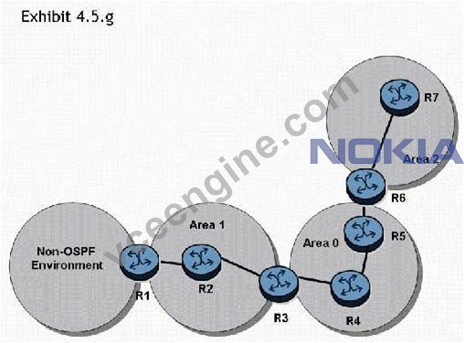
In the topology shown, router R1 is an ASBR configured to export external routes to OSPF. Assuming that there are no stub networks, which of the following statements regarding type 4 LSA generation is true?
- A. Router R3 generates a type 4 LSA that is flooded to areas 0 and 2.
- B. Router R3 generates a type 4 LSA that is flooded to areas 0, 1, and 2.
- C. Router R3 generates a type 4 LSA that is flooded to area 0, and router R6 generates a type 4 LSA that is flooded to area 2.
- D. Router R1 generates a type 4 LSA that is flooded to areas 0, 1, and 2.
Answer: C
NEW QUESTION # 48
Click the exhibit button.

The OSPF adjacency between routers R3 and R1 is down. What is the problem?
- A. There is not enough information to tell.
- B. Area 1 of router R1 should not be configured as a stub.
- C. Router R1 has the incorrect authentication key type.
- D. Router R3 has the incorrect authentication key type.
Answer: C
NEW QUESTION # 49
Click the exhibit button.
If router R2 redistributes the IS-IS route to 192.168.3.0/24 into OSPF, router R3 will receive two routes to 192.168.3.0/24. What will be the preference of these two routes? Assume that all IS-IS routers are L1/L2 capable and are in the same are a. Choose two answers.
- A. The IS-IS Level 1 internal preference
- B. The OSPF external preference
- C. The IS-IS Level 1 external preference
- D. The IS-IS Level 2 internal preference
- E. The OSPF internal preference
- F. The IS-IS Level 2 external preference
Answer: A,B
NEW QUESTION # 50
What is the source IP address in an OSPF update?
- A. The system address of the router
- B. 224.0.0.6
- C. 224.0.0.5
- D. The unicast IP address of the interface the update is being sent on.
Answer: D
NEW QUESTION # 51
In an OSPF Hello packet what fields must match all neighbor routers on the segment? (Choose 3)
- A. The list of neighbors
- B. Stub flag
- C. Hello and Dead Intervals
- D. DR and BDR addresses
- E. Area ID
Answer: B,C,E
NEW QUESTION # 52
What are the default Hello and Dead timer intervals for OSPF on the Nokia 7750 SR?
- A. 5 and 15 seconds
- B. 10 and 40 seconds
- C. 10 and 30 seconds
- D. 5 and 20 seconds
Answer: B
NEW QUESTION # 53
In an OSPF environment, what must a router receive after it sends out an update?
- A. The router must receive a new sequence number
- B. The router must receive a Link State Packet
- C. The router must receive an acknowledgment
- D. The router must receive a Hello
Answer: C
NEW QUESTION # 54
In an IP datagram, which field identifies the receiving application
- A. The protocol field of the transport layer header
- B. The port field of the network layer address
- C. The port field of the transport layer header
- D. The protocol field of the network layer header
Answer: C
NEW QUESTION # 55
......
Nokia 4A0-113 exam is intended for network engineers, administrators, and technicians who are responsible for designing, deploying, and maintaining OSPF networks using Nokia equipment. 4A0-113 exam covers a wide range of topics, including OSPF concepts and theory, network design and implementation, configuration and optimization, and troubleshooting.
4A0-113 Deluxe Study Guide with Online Test Engine: https://actualtests.vceengine.com/4A0-113-vce-test-engine.html
